
If your dog pulls on the leash, the shortest answer is this: pulling has worked for your dog so far. If you kept walking whenever the leash went tight, your dog has learned the rule "if I pull, I move forward." Loose leash walking training reverses that rule: when the leash tightens, the walk stops; when the leash goes slack, the walk continues. With the right equipment, short and consistent repetitions and well-timed rewards, most dogs start to understand this new rule within a few weeks. Below we explain the method step by step.
Why Do Dogs Pull on the Leash?
A dog's natural walking pace is faster than most people's; it wants to reach a world full of smells, sounds and movement as quickly as possible. Add to that the "opposition reflex": when pressure comes on the neck or chest, a dog instinctively leans into it. That is why hauling back on the leash usually increases pulling rather than reducing it.
The real driver, though, is learning. As we explain in how do dogs learn, a behavior with a pleasant outcome gets repeated. Reaching the park, the tree or another dog on a tight leash is a reward for the dog. So pulling is not "stubbornness"; it is a habit that has been rewarded again and again.
Which Equipment Should I Choose Before Training?
Equipment does not replace training, but the wrong equipment makes training harder. Our recommendation for a start is simple:
- Leash: a fixed leash 1.5–2 meters long. Retractable (flexi) leashes teach the dog constant light tension; do not use them during training.
- Harness or collar: a well-fitted Y-shaped harness that does not restrict shoulder movement, or a flat collar. We do not recommend pain-based tools such as choke chains or prong collars.
- Rewards: small, soft treats your dog genuinely loves; a treat pouch makes things easier.
If you notice coughing, breathing difficulty or neck sensitivity while your dog pulls, pause the training and consult your veterinarian.
How Do You Teach Loose Leash Walking Step by Step?
Apply the steps below in order, each until it is solid. Going back to the previous step when one gets hard is not a step backwards; it strengthens the foundation.
Step 1: Define the reward zone
Choose the side you want your dog to walk on (most people choose the left) and always deliver the reward on that side, level with your leg. In a few minutes of off-leash practice at home, your dog learns that standing beside you "pays." When the reward always arrives at the same spot, the dog starts returning to that spot on its own.
Step 2: Start somewhere with few distractions
The first on-leash sessions should happen indoors, in the garden or on a quiet street. Teaching a new skill in a busy park is like studying in a noisy café. Making the environment harder comes only after the dog succeeds in a calm one.
Step 3: Stop the moment the leash tightens
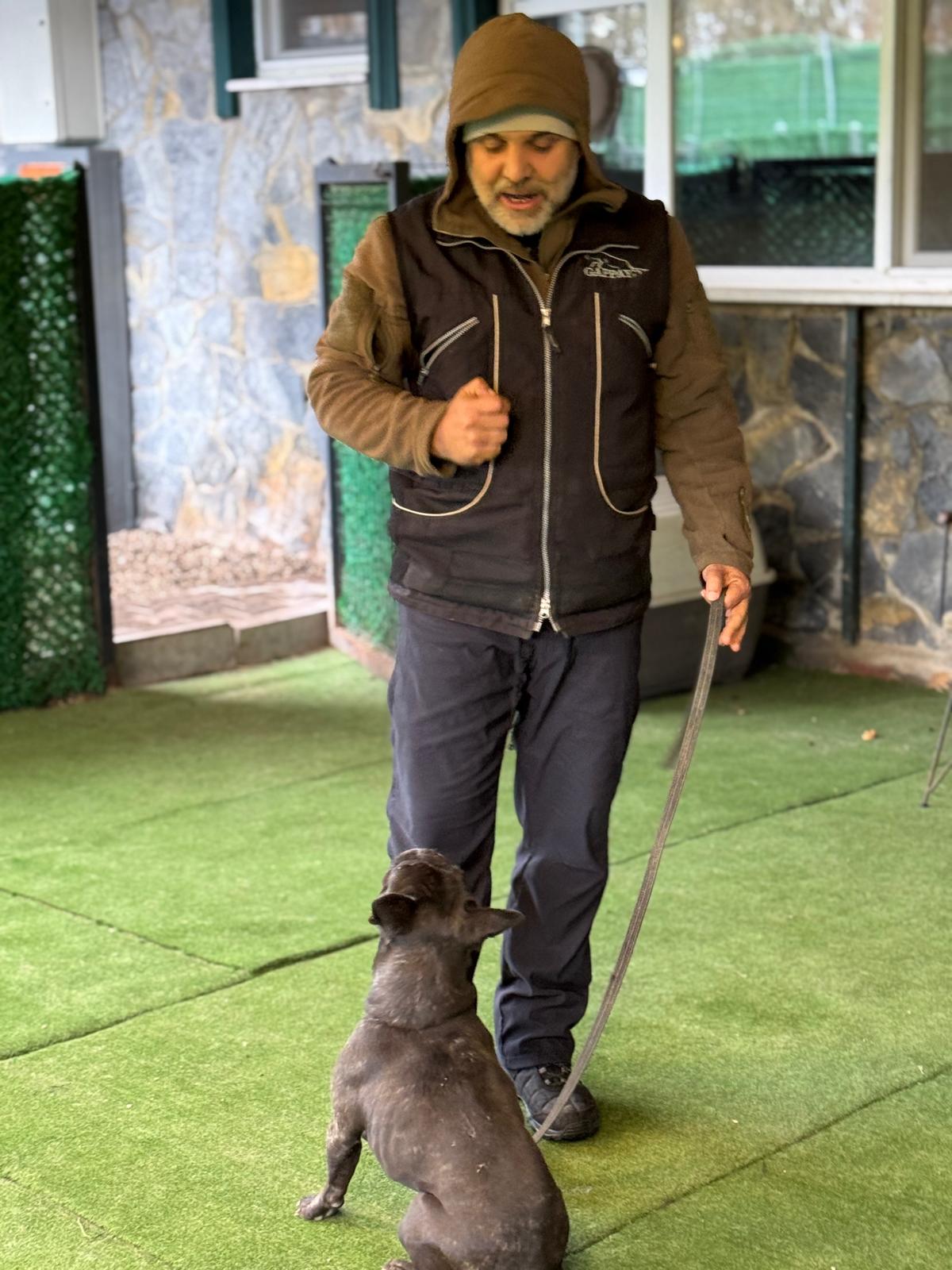
When the leash tightens on a walk, stop where you are and wait like a tree. Do not talk and do not pull the leash back. When your dog turns to look at you or takes a step back and the leash slackens, say "yes," give the reward beside you and keep walking. The rule is clear: tight leash = stop, loose leash = go.
Step 4: Change direction to connect attention to you
When your dog gets ahead of you and starts pulling, give a calm verbal cue (such as "this way"), turn around and walk in the opposite direction. Reward your dog the moment it catches up beside you. This game teaches the dog that you decide where you go and that following you pays off. The turn should be smooth, never a hard jerk.
Step 5: Thin out rewards, extend the distance
At first, reward every few steps taken on a loose leash. As your dog understands the rule, spread rewards over longer distances and sometimes use "life rewards" such as permission to sniff instead of a treat. Thinning rewards gradually, not stopping them all at once, is what makes the behavior last.
Step 6: Make the environment harder gradually
Move a dog that succeeds on a quiet street first to a slightly busier street, then to the edge of the park. In every new environment, lower your expectations a little and increase the reward rate again. Dogs do not automatically generalize what they learn to every setting, so the same practice has to be repeated in different places.
What Are the Most Common Mistakes?
- Inconsistency: sometimes stopping and sometimes being pulled along teaches the dog that pulling "sometimes" works, which makes the habit even stronger. Everyone at home who walks the dog must follow the same rule.
- Always keeping the leash short: on a leash that is always tight, the dog never experiences what a loose leash is.
- Hard jerks: yanking the leash can frighten the dog, make walks stressful and damage trust.
- Working in a hard setting with a dog that still has energy to burn: a dog that has been indoors all day wants to burst outside. A short play or sniffing break before a training walk makes your job easier.
- Sessions that are too long: focused 10–15 minute sessions are more productive than an exhausting one-hour walk.
For broader training habits, see our top 10 dog training tips.
Is There a Difference Between Puppies and Adult Dogs?
With a puppy your job is easier: there is no established pulling habit yet, and the right rule can be taught from day one. Sessions with a puppy should be very short and respect its attention span. With an adult dog, the old habit has been rewarded for a long time, so the first weeks take more patience; but age is no barrier to learning. Loose leash walking is one of the parts of basic obedience training that shows most in daily life; practiced together with sit, stay and recall, it settles much faster.
When Do You Need Professional Help?
If you see no progress despite consistent practice at home, or if any of the following sounds familiar, it is time to hand the job to a professional:
- Your dog pulls hard enough to knock you over or injure you.
- The pulling comes with barking, lunging or aggression toward other dogs or people.
- Your dog shows signs of fear outside: trying to flee, trembling or freezing on the spot.
- Several people walk the dog at home and it is not possible for everyone to follow the same rule.
In these cases pulling is often not a problem on its own but the sign of an underlying emotion; we explain this difference in detail in our behavior correction training article. At our dog training center in Zekeriyakoy, we first get to know and assess your dog; the right program is decided in that assessment. Programs are designed by our trainer Irsat Uner with the ICONK9 system and are based on positive reinforcement. During training your dog can board at the facility, so the walking rule is repeated every day within the daily routine. For program fees, see our pricing page.
Frequently Asked Questions
How long does it take for my dog to stop pulling on the leash?
In most families who practice briefly and consistently every day, the first clear difference shows within a few weeks. The timeline depends on the dog's age and energy, how old the habit is, and whether everyone at home follows the same rule. A dog that is sometimes rewarded for pulling and sometimes not will take longer.
Should I use a harness or a collar for a dog that pulls?
A well-fitted Y-shaped harness that does not press on the neck, or a flat collar, is enough. Training does the real work, not the equipment. We do not recommend pain-based tools such as choke chains or prong collars; if you notice coughing, breathing difficulty or neck pain while your dog pulls, consult your veterinarian.
Can an adult dog learn to walk without pulling?
Yes. Adult dogs learn the new walking rule too; because the old habit has been rewarded for a long time, the first weeks simply call for more patience and consistency. Regular practice matters far more than age.
Does a retractable (flexi) leash make pulling worse?
Usually, yes. On a retractable leash the dog feels light tension with every step and learns that pulling is how it moves forward. During training, a fixed 1.5–2 meter leash shows the dog much more clearly what a loose leash means.
When should I get professional training help?
If you see no progress after a few weeks of regular practice, if your dog pulls hard enough to knock you over, or if the pulling comes with barking, lunging or fear toward other dogs, you need professional support. In that case your dog is assessed first, and the right program is decided at the consultation.